
Climate Governance

Organizational Governance Structure
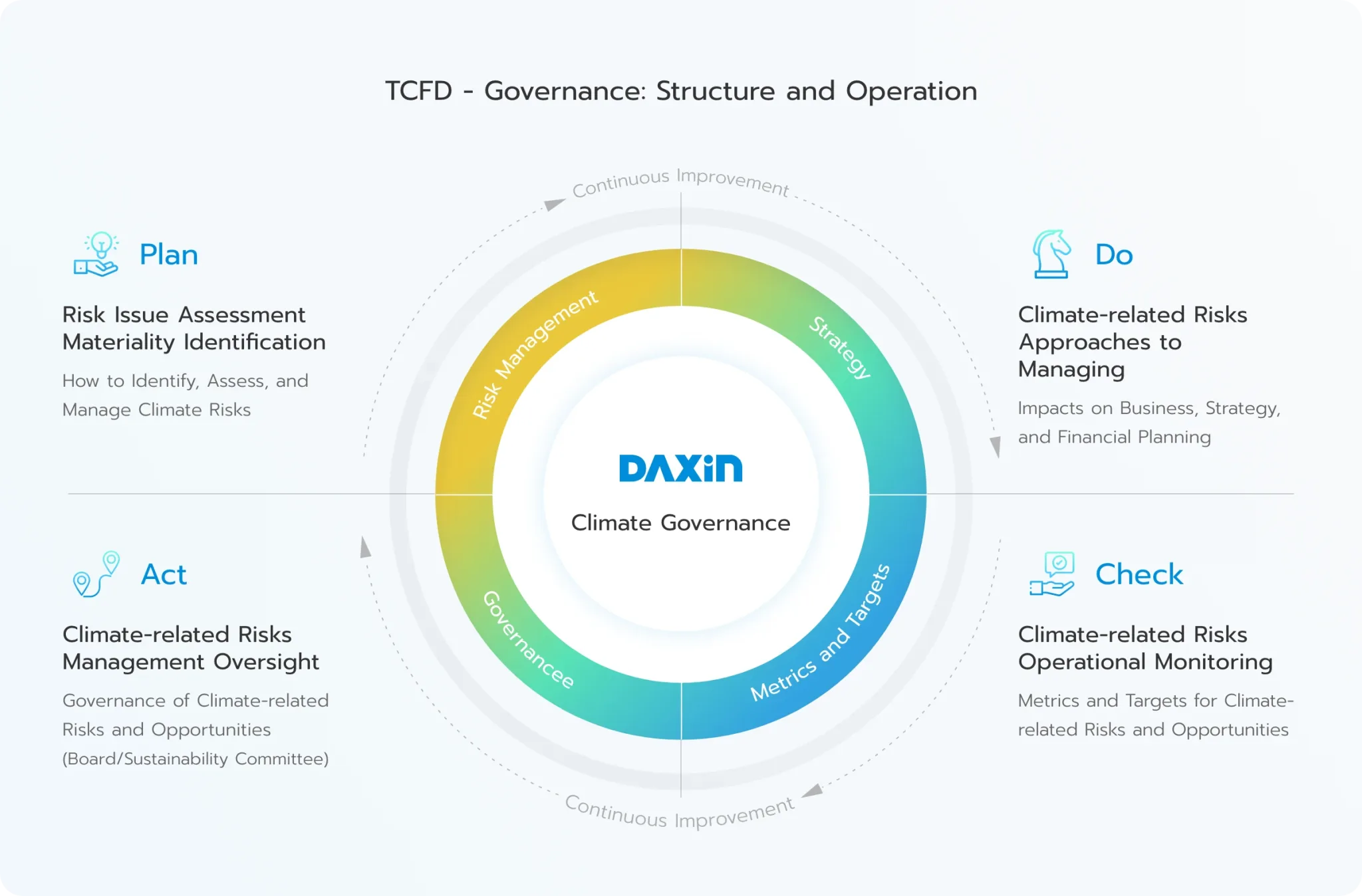
Daxin's Sustainable Development Committee oversees climate action and management mechanisms, conducting climate-related risk and opportunity assessments in alignment with the TCFD framework
to formulate response strategies and set management targets. The Company also references the IFRS S2 framework to disclose governance, strategy, risk management, and climate-related metrics and
targets. Progress is reported to the Board of Directors annually, with the Board fulfilling its oversight responsibilities.
Supervisory Body

Board of Directors
Oversee
sustainability
initiatives and
provide
guidance as
appropriate.
Management Body

Sustainable Development Committee
- Identify material sustainability issues, climate-related risks and opportunities.
- Review and approve sustainability policies, strategic planning, and response actions.
- Report sustainability performance and progress to the Board of Directors.
Working Group

Environmental Sustainability Task Force
- Implement climate risk management and mitigation and adaptation actions.
- Track progress toward climate targets. (quarterly)
- Report climate risk management performance to the Sustainable Development Committee. (annually)
Identification and Management Process
With reference to the TCFD recommendations, Daxin has established a “Climate-related Risk and Opportunity Management Process.” This process comprises six key stages—issue identification, executive engagement, risk assessment, risk identification, response strategy development, and management tracking—enabling a systematic approach to identifying and evaluating material climate-related risks and opportunities relevant to the Company.
Climate-related Risk and Opportunity Management Process

Issue Identification
- TCFD Sector-specific Disclosure Guidance
- Group, Benchmark, and Peer TCFD Reports
Management Involvement
Senior Leadership Survey Participation
Risk Assessment
Scoring Based on Likelihood and Impact
Risk Identification
Prioritizing Risks and Opportunities
Response Strategies
Strategies for High Risks and Opportunities
Management Tracking
Tracking with Defined Metrics and Targets

Transition Risks 9 items
Risks from Low-Carbon Transition: Regulatory, Tech, and Market Changes
Regulations
- Carbon Tax Implementation
- Net Zero Emissions
- EIA Commitments
Technology
- Renewable Energy Transition
- Low-Carbon / Green Product Development
- Development of Advanced Energy-Efficient Technologies
Market
- Customer Sustainability Engagement
- Increase in Raw Material Costs
Goodwill
- Corporate Reputation Impact
Physical Risks 4 items
Financial Risks from Acute and Chronic Climate Events
Immediate
- Typhoons / Flooding / Inundation (Own Operations)
- Heatwaves / Drought / Water Scarcity (Own Operations)
- Typhoons / Drought / Flooding (Supply Chain)
Long-term
- Temperature Increase / Sea Level Rise
Opportunities 12 items
Daxin’s Mitigation and Adaptation Opportunities
- Low-Carbon and Green Production
- Resource Circularity
- Low-Carbon Product Development
- Facility Energy Efficiency Enhancement
- Renewable Energy Participation
- New Market Development
- Government Incentive Acquisition
- Water Efficiency Improvement
- Enhanced Climate Resilience
- Enhanced Corporate Reputation
- Supplier Risk Reduction
- Procurement Cost Reduction