


Investor Relation
Board of Directors
| Name | Title | Education & Current/Selected Past Position |
| Cheng-Yih Lin (C.Y.) | Chairman |
Ph.D., Chemical Engineering,Carnegie Mellon University
Senior Vice President, AUO Corp.
Director, AUO Corp.
Chairman, AUO Crystal Corp.
Chairman & Chief Executive Officer, Daxin Materials Corporation
|
| Tsung-Hsing Kuo | Vice Chairman |
B.S., Chemical Engineering, National Taiwan University
E.M.B.A., National Sun Yat-sen University
President, Eternal Chemical (China) Co., Ltd.
President, Daxin Materials Corporation
Vice Chairman, Daxin Materials Corporation
|
|
Chin-Yuan Chen
|
Director
【Representative of Konly Venture Corporation】
|
B.S., Chemical Engineering, National Taiwan University
Vice President, Chief Technology Officer & Operating chief, Eternal Materials Co. Ltd.
Director, Consultant to the President‘s Office & Chief Industry Development Strategy Officer, Eternal Materials Co. Ltd.
|
| Ting-Li Lin |
Director
【Representative of Konly Venture Corporation】
|
M.S., Applied Chemistry National Chiao Tung University
Senior Vice President, AUO Corp.
Director, AFPD Pte. Ltd.
Director, BriView (Xiamen) Corp.
|
| Yen-Chen Liu | Director |
E.M.B.A., National Tsing Hua University
Accounting Manager, AUO Corp.
Chief Finance Officer, Daxin Materials Corporation
Representative of the Director, Frontier Materials (Samoa) Corporation
|
| Xin-Wu Lin | Independent Director |
Ph.D., Economic, National Taiwan University
Committee Member, 6th term of the Fair Trade Committee, Executive Yuan
Director of Research Division III & Research Fellow, Taiwan Institute of Economic Research
Adjunct Professor, School of Law, National Yang Ming Chiao Tung University
Independent Director, FitTech Co.,Ltd.
Vice President & Research Fellow, Taiwan Institute of Economic Research
Independent Director, Taiwan Business Bank, Ltd.
Chief Consultant of Compliance, AUO Corp.
|
| Wei-Shun Cheng | Independent Director |
M.S., Accounting, Northern Illinois University
Chief Financial Officer and Senior Vice President, AUO Corp.
Director, Darwin Precisions Corporation
Director & Vice President, M.SETEK Co., Ltd.
Director, Lextar Electronics Corp.
Director, SHIRRE LAB Corp.
Independent Director, Raydium Semiconductor Corporation
Independent Director, Chenbro Micom Co., Ltd.
Independent Director, Unictron Technologies Corporation
|
| Chiao-Mou Cheng | Independent Director |
B.S., Chemical Engineering, Chung Yuan University
Assistant Vice President & Vice Director of Research Division, Eternal Materials Co. Ltd.
|
| Chih-Chun Tsai | Independent Director |
M.S., Computer Science, Utah State University
Assistant Researcher, Engineering Division, National Science Council
Senior Director, Asia/ Pac Business, Taiwan Semiconductor Manufacturing Company Limited
Independent Director, Leadtrend Technology Corporation
Director, Coretech Optical Company, Ltd.
Chairman, Hua Jieh Investment Co., Ltd.
Director, Egis Technology Inc.
Representative Director, Lionic Corporation
|
The company‘s "Corporate Governance Principles"
clearly stipulates that the composition of the board of directors shall be
determined by taking diversity into consideration. It is advisable that
directors concurrently serving as company officers not exceed one-third of the
total number of the board members, and that an appropriate policy on diversity
based on the company‘s business operations, operating dynamics, and development
needs be formulated and include, without being limited to, the following two
general standards:
|
The management goals and achievements
|
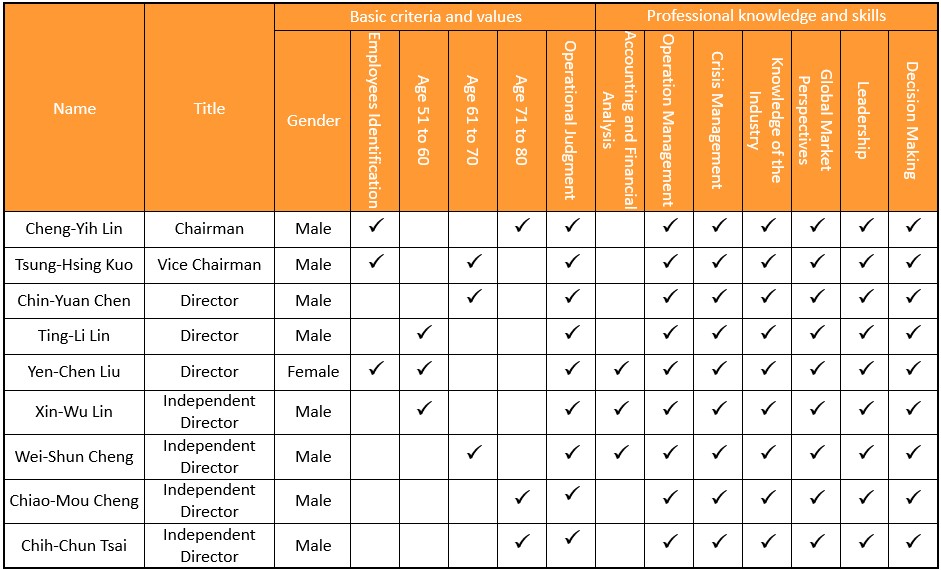
Daxin has 9 Directors (including 4 Independent Directors). All members of the board possess diverse industry backgrounds and rich experience in chemistry, chemical engineering, semiconductor, business management, financial management and more. In order to achieve the goal of corporate governance, the Board of Directors shall possess core abilities including operational Judgment, accounting and financial analysis, operation management, crisis management, knowledge of the industry, global market perspectives, leadership, and decision-making. 33% of the Board of Directors concurrently serve as Daxin‘s employees. The ratio of Independent Directors to all Directors is 44%. There are no the spouses, or relatives within the second degree of kinship to Directors of the Company.
.png) |
Performance Evaluation
|
The Company‘s "Rules for Performance Evaluation of Board of Directors" were revised and approved by the Board of Directors on November 6, 2024. The policy clearly defines the scope, covering the evaluation of the Board of Directors, individual directors, and functional committees. An internal performance evaluation of the Board of Directors shall be conducted annually. The evaluation criteria are divided into five grades: Excellent, Very Good, Good, Fair, and Needs Improvement. Additionally, an external evaluation shall be conducted by an independent professional institution or a panel of external experts and scholars at least once every three years. The results of both internal and external performance evaluations shall be completed by the end of the first quarter of the following year and reported to the Board of Directors. The criteria for evaluating the performance of the Board of Directors, covering the following five aspects: The criteria for evaluating the performance of the Board members, covering the following six aspects: The criteria for evaluating the performance of functional committees, covering the following five aspects: |
Internal Performance Evaluation
|
The company has completed the internal performance evaluation of the Board of Directors for 2025 (evaluation period: 2025.1.1-2025.12.31). The evaluation scope includes the "Board of Directors", "Individual Directors", "Audit Committee" and "Remuneration Committee.” The evaluation results will be reported to the Board of Directors in the first quarter of 2026. The overall evaluation results for the Board of Directors and all functional committees for 2025 have been rated as "Excellent". The attendance rate of the Board and all functional committees reached
100%, with all directors actively participating in and diligently supervising
the Company‘s operations, and each functional committee effectively performed
its duties, demonstrating that the Board operates well and corporate governance
can be effectively enhanced.The performance evaluation results are as follows: |
External Performance Evaluation
|
The company commissioned the "Taiwan Investor Relations Institute (TIRI)" to conduct the external performance evaluation of the Board of Directors for 2024. The assessment covered five aspects: (1) Board composition and professional development, (2) Quality of decision-making, (3) Operational efficiency, (4) Internal control and risk management, and (5) The Board‘s involvement in corporate social responsibility. The evaluation was conducted through a review of company-provided documents, self-assessment questionnaires, and on-site interviews. The evaluation results will be reported to the Board of Directors in the first quarter of 2025. Independence of the External Institution Recommendations Improvement Plans Please refer to the Board of Directors External Performance Evaluation Certification and Report |
|
Election SystemElection System Diversity Policy The company continuously seeks, cultivates, and evaluates suitable director candidates through the following sources:
Performance Evaluation |
Talent Pool
|
